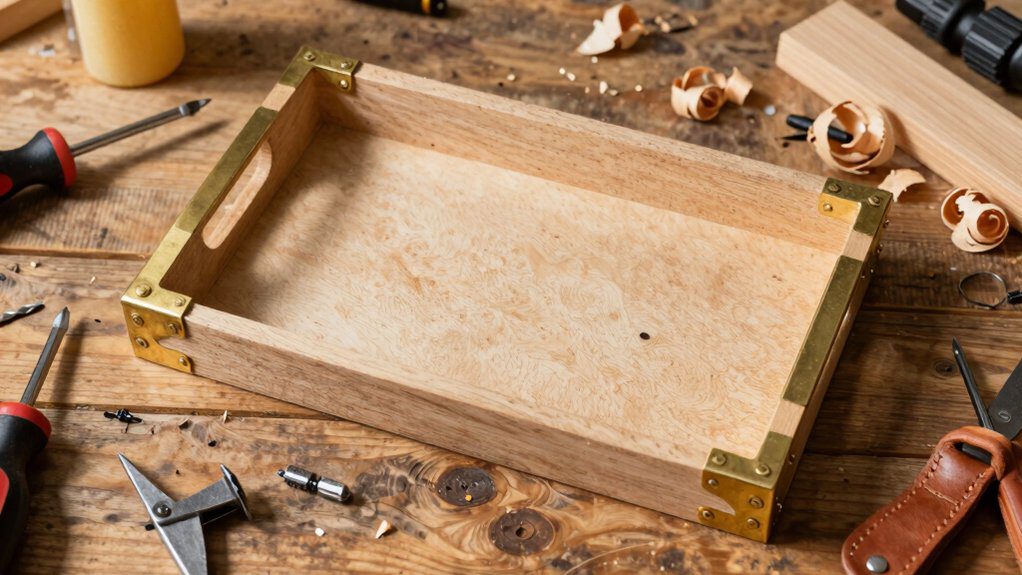
How To Make a Yardstick Serving Tray (Step-by-Step DIY Tutorial)
Transform wooden yardsticks into a stunning serving tray by cutting four to five sticks to your desired length, typically 12–14 inches wide. Glue them side-by-side onto a plywood base, then reinforce underneath with cross-supports spaced evenly. Add handles by positioning yardstick pieces 1–1½ inches down from the top edge. Sand everything smooth with 120–220 grit sandpaper, then seal with polyurethane or wax for durability. The finishing touches—whether clear coat or dark wax—really make your tray shine.
Love cozy DIY projects? 💕
Get free printable guides, exclusive tutorials & surprise craft goodies straight to your inbox.
Disclosure: This post may contain Amazon affiliate links, at no extra cost to you. Content on DiyCraftNest is created with research support from AI tools and carefully reviewed, edited, and fact-checked by the lead author, Daniel Pat, to ensure accuracy and reliability. Learn more
Key Takeaways
- Inspect four to five 36-inch hardwood yardsticks for defects and sort by finish for matching appearance before assembly.
- Cut yardsticks to length (typically 12–18 inches), sand edges smooth, and dry-fit pieces to verify gap-free alignment across the tray.
- Sand mating surfaces with 120–150 grit, apply thin wood glue beads, and clamp every 6–8 inches using protective cauls.
- Attach handles at centerline marks 1–1.5 inches down from top edge, ensuring balanced placement and comfortable grip on both sides.
- Sand progressively from 100–220 grit, dust thoroughly with damp cloth, then apply polyurethane, tung oil, or water-based finish for protection.
Materials You Will Need
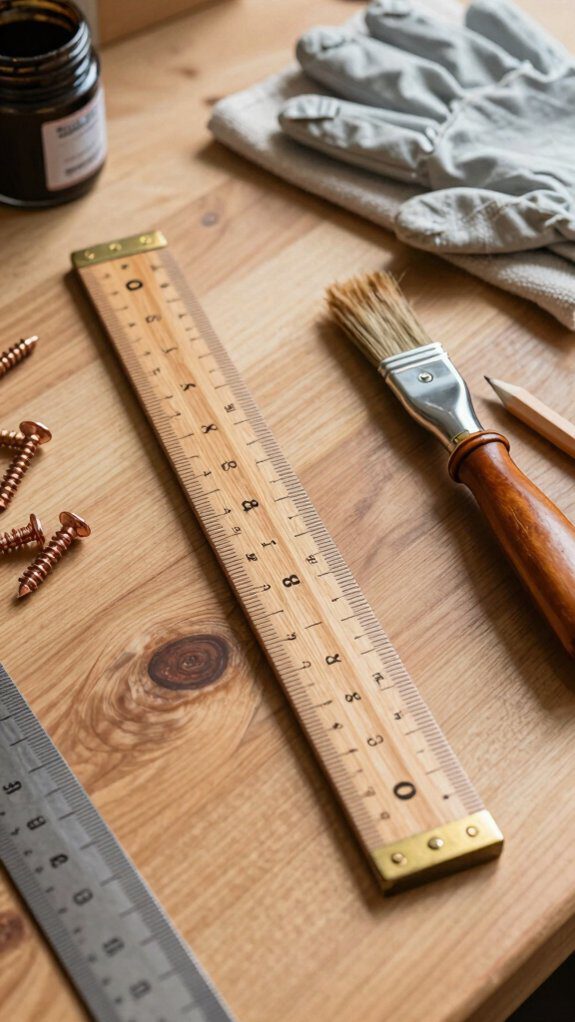
Before you get started on this fun project, you’ll want to gather a few indispensable supplies that’ll make the whole process smooth and enjoyable. The foundation of your tray starts with wooden yardsticks, wood glue to hold everything together, a plywood base for stability, handles for easy carrying, and clamps to keep pieces secure while the glue dries. I’ll walk you through each of these materials so you know exactly what to pick up and why they matter for building your own custom serving tray.
Wooden yardsticks
The foundation of your serving tray starts with choosing the right yardsticks—and I’d recommend grabbing four to five wooden ones at standard 36-inch length. I prefer hardwood or birch for durability, though vintage rulers work beautifully if you reinforce them properly.
Before assembly, inspect each stick carefully for cracks, chips, or wobbly metal end caps, then sand rough edges smooth. If you want matching colors, sort by finish or plan to paint afterward—spray paint and chalk paint both stick wonderfully.
Don’t toss those 9–14 inch scraps; they’re perfect for decorative inlays and handles that minimize waste while adding character.
Wood glue
Grab yourself a quality wood glue like Titebond or Gorilla Wood Glue—this is where your serving tray’s durability really comes down to one pivotal choice.
I’ll apply a thin, even bead along each yardstick’s back rather than using globs, which prevents messy squeeze-out.
After positioning each piece, I’ll use careful clamping with a heavy book or weighted cans to guarantee tight bonds.
Then comes patience—I’ll let everything set for thirty minutes initially, but I won’t rush.
Full glue curing takes a complete twenty-four hours before I stress-test my creation.
This wait guarantees a tray that’ll last for years.
Plywood base
Your plywood base is essentially the foundation that’ll make or break your serving tray’s functionality and longevity.
I recommend selecting quality materials for durability:
- Choose furniture-grade plywood (birch or maple veneer) for a smooth, splinter-free surface
- Consider marine plywood or acoustic underlayment for improved moisture resistance
- Cut your sheet to match interior tray dimensions, allowing yardstick edges to sit flush
Sand edges and surfaces with 120–220 grit sandpaper, then wipe clean.
Before gluing yardsticks, seal everything with primer, stain, or polyurethane to prevent warping.
This prep work converts your base into a sturdy, beautiful foundation that’ll impress everyone who uses your handmade tray.
Handles
Creating comfortable handles transforms your serving tray from functional to genuinely user-friendly, and I’ll walk you through two solid approaches.
You can cut slots into the tray ends for a sleek look, or attach yardstick pieces across the inside for raised handles. Either method gives you ergonomic grips that feel natural in your hands.
I prefer sanding handle edges into rounded profiles—they’re so much more comfortable!
You might even add decorative inlays along the seams for visual interest.
Finish everything with dark furniture wax or polyurethane to seal wood and smooth any roughness, creating handles that look as good as they feel.
Clamps
Holding everything together while the glue dries is where clamps become your best friend—and honestly, they make the difference between a tray that stays solid and one that falls apart.
For clamp selection, I recommend:
- Small bar or spring clamps (4–6 inches) for securing yardstick pieces to the tray during curing
- Low-profile F-clamps or mini-sash clamps positioned every 6–8 inches along longer seams for even pressure
- Rubber-padded jaws with ½-inch throat depth to grip across the assembled width safely
Use protective cauls—wood scrap blocks between clamp jaws and yardsticks—to protect painted surfaces.
No clamps? Weighted boards work overnight, but clamps deliver faster, more reliable results.
Sandpaper
The right grit makes all the difference when you’re prepping those yardstick pieces for assembly. I recommend having both 120–220 grit sanding sponges and sandpaper on hand for smooth cut edges without damaging printed numbers.
For thicker pieces or rougher cuts, I start with 100–120 grit, then finish with 180–220 grit for that polished feel. Your grit selection determines edge preservation—sand gently along the grain using light, even strokes to avoid gouging thin wood.
After sanding, I wipe everything with a damp cloth to remove dust before finishing. This simple prep work really transforms your project’s final appearance.
Clear sealant or stain
Once you’ve sanded those yardstick pieces smooth and wiped away the dust, you’re ready for the fun part—bringing out the beauty of your tray with a protective finish.
You’ve got several great options:
- Clear polyurethane (water- or oil-based) applied in 2–3 thin coats with light sanding between each
- Oil-based wood stain like Minwax to enrich grain, then sealed with polyurethane
- Low VOC finishes (water-based) that dry quickly without ambering
For that vintage charm, consider aging wax effects—rub dark furniture wax into edges after sealing to highlight numbers and create subtle patina.
Choose what matches your style!
Tools Required
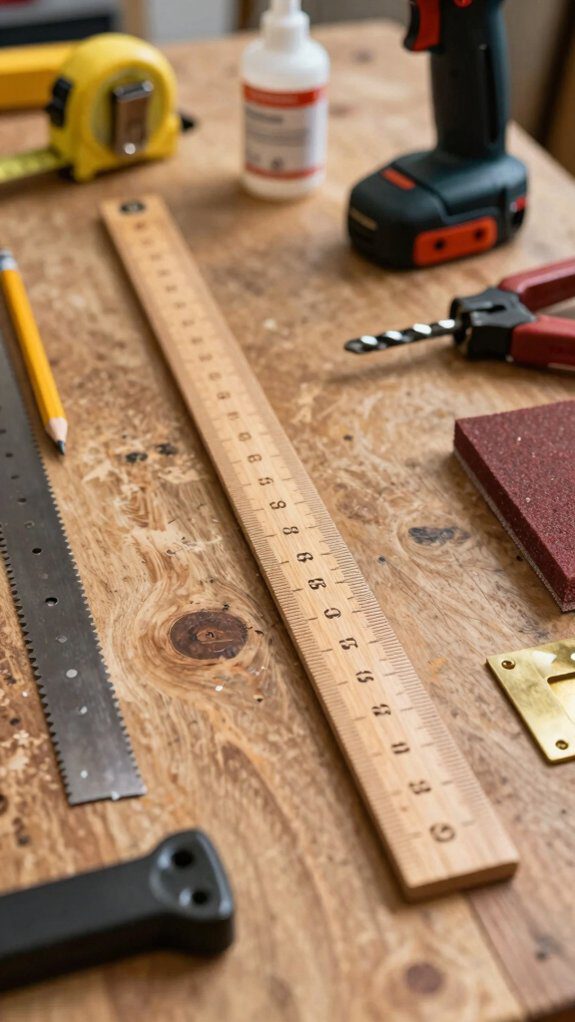
Before you start building your serving tray, you’ll want to gather a few vital tools that’ll make the whole process smoother and way more enjoyable.
A saw—whether it’s a hand saw or a miter box with saw—is your best friend for making clean, straight cuts on those yardsticks, while a measuring tape guarantees you get your measurements spot-on every single time.
You might also want to have a drill on hand for any custom holes or decorative touches you’d like to add to your finished tray.
Saw
Cutting your yardsticks cleanly is crucial if you want your serving tray to look polished and professional, so choosing the right saw matters more than you might think. Here’s what I recommend for tool selection and safety precautions:
- Hand saws or miter box saws deliver straight cuts without electricity
- Utility knives work for thinner pieces but require multiple passes and sanding
- Electric saws need fine-tooth blades (120+ TPI) and secure clamping
I always keep a sanding sponge nearby to smooth edges and remove splinters after cutting. A miter box is perfect when you’re making multiple identical lengths—think eight 18-inch pieces—or need precise 45° angles.
This approach guarantees your tray components fit together beautifully.
Drill
A cordless drill is your best friend when it comes to assembling your serving tray—it’ll save you time and help you create a sturdy, professional-looking project.
Proper bit selection makes all the difference: use 1/16″ to 1/8″ pilot bits for pre-drilling, preventing wood splitting on thin yardstick pieces. For handle hardware, match your bit to the screw size, typically 7/64″–1/8″ for standard screws. Don’t forget countersinking larger holes so screw heads sit flush.
Keep your drill maintenance routine simple by cleaning debris regularly.
Work slowly at low torque, backing your workpiece with scrap wood to minimize splintering.
Measuring tape
Once you’ve got your drill ready to go, you’ll want to grab a reliable measuring tape—it’s just as important as your torque tools because accuracy with your measurements directly affects how well everything fits together.
I’ll show you exactly what makes a measuring tape indispensable for this project:
- Choose a retractable tape marked in inches and fractions (1/8″, 1/16″) for precise measurements
- Practice proper tension control by keeping the tape taut and level across surfaces to prevent sagging errors
- Verify tape calibration regularly so your yardstick strips line up perfectly
Always measure twice before marking with pencil, ensuring repeatable cuts and snug final assembly.
Step 1: Plan the Tray Size
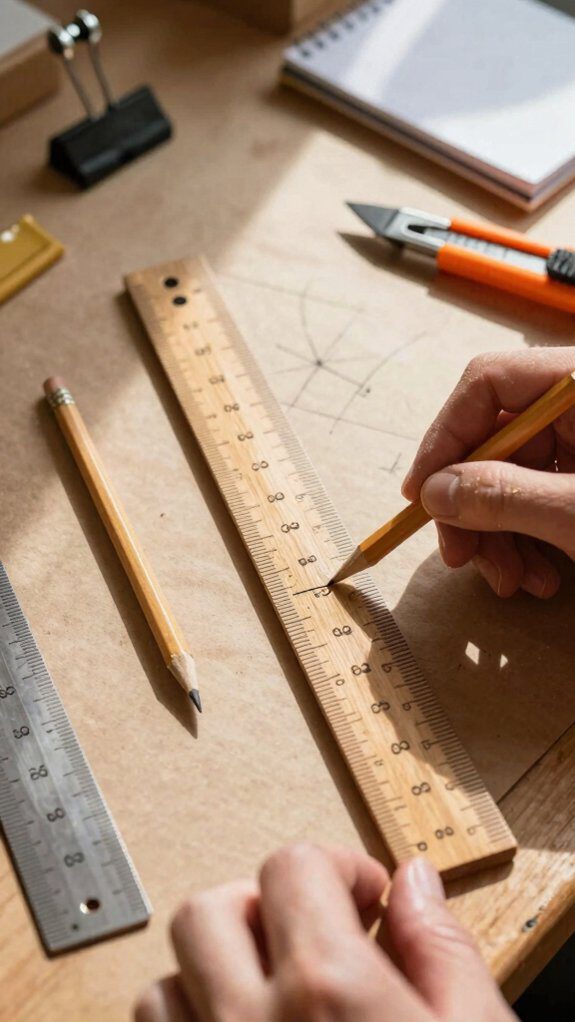
Before you make a single cut, lay out your yardsticks side-by-side on a flat surface to visualize the tray’s final dimensions—this is where your design really comes to life. I like to arrange them in the exact configuration I’m planning (whether that’s four pieces for the frame or three for the base) so I can see how they’ll actually fit together.
This quick dry run takes just a few minutes but saves you from cutting mistakes and helps you spot any gaps or overlaps before you’re committed to the wood.
Arrange yardsticks for layout
To create a serving tray that actually fits your space, you’ll start by measuring your tray base and deciding on your finished width—typically somewhere between 12 and 14.5 inches, though you can absolutely go with whatever measurement works best for you.
Now here’s where the fun begins—arranging your cut yardstick pieces into a layout you’ll love.
- Lay slats side-by-side, alternating colors or number orientations for pattern balance
- Experiment with orientation contrast to create visual interest across the surface
- Position three cross-support trim pieces underneath to test spacing before committing
Before gluing anything, set your arrangement into the actual tray.
Check gaps, straightness, and handle clearance carefully.
Step 2: Cut and Trim to Fit
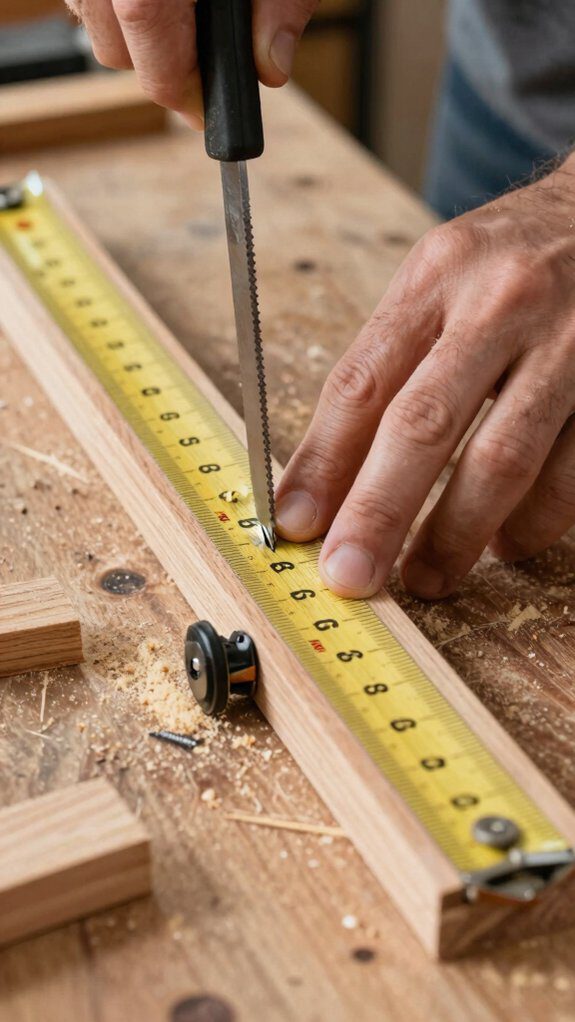
Now comes the satisfying part where you’ll cut your yardsticks to size and make sure everything fits perfectly on your tray. I measure the tray width first, then mark each yardstick at the lengths I need—typically 18 inches for the sides and 12 inches for cross pieces—so all my pieces match up nicely.
Once I’ve made clean cuts with a miter box or hand saw, I lay everything out on the tray to check the fit and trim a few millimeters here and there until the pieces sit snugly without any gaps.
Ensure even edges
Getting your yardstick pieces cut to exactly the same length is what separates a polished-looking tray from one that looks a little off, and I’m going to walk you through how to nail it.
After cutting, here’s your action plan:
- Sand the ends – Use a sanding sponge on all pieces to remove minor length differences and guarantee flush edge alignment
- Stack and check – Place pieces against a straightedge to spot high spots, then trim with a saw or box cutter
- Dry-fit and measure – Test pieces on your tray across multiple points, adjusting individual pieces until edges form a uniform straight line
Seam reinforcement starts with this precision work.
Step 3: Attach Yardsticks to the Base
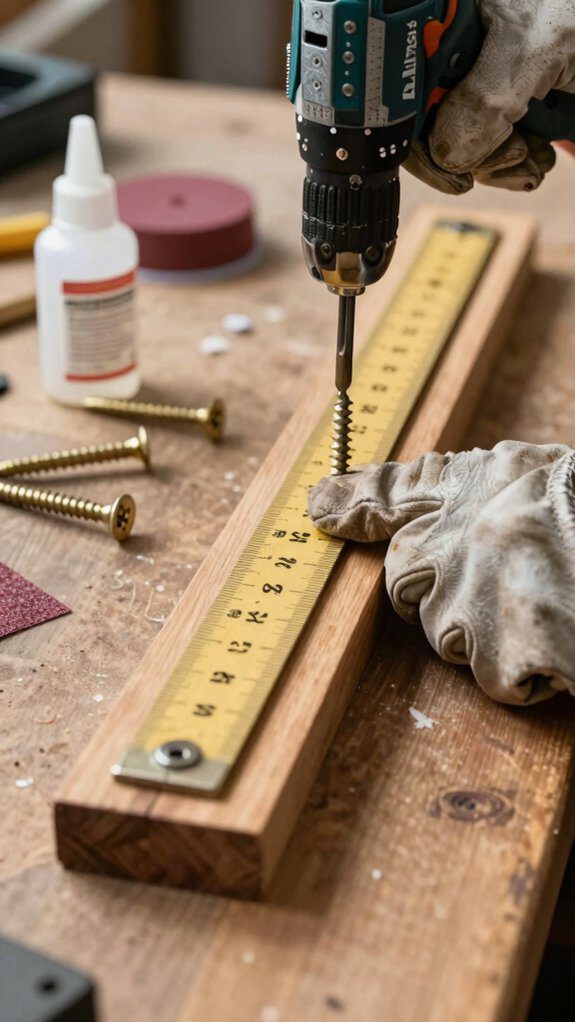
Now I’ll glue those yardstick pieces down evenly, making sure to apply adhesive consistently so every strip bonds properly to the base.
I’ll clamp or weight them securely while the glue cures—whether I’m using quick-setting hot glue or stronger wood glue overnight—so nothing shifts or lifts as it dries.
This step’s all about patience and pressure, since a solid, flat foundation makes the difference between a tray that lasts and one that falls apart.
Apply glue evenly
This is where your patience really pays off—applying glue correctly makes the difference between a tray that holds together beautifully and one that wobbles.
I’ve learned that the glue application method depends on your chosen adhesive:
- Hot glue: Work in 6–8 inch sections, applying thin beads so the glue stays tacky for placement before glue drying affects positioning.
- Wood glue: Spread a 1/8-inch even line using a craft stick, avoiding excess squeeze-out that creates messy edges.
- Gorilla glue: Apply sparingly to both surfaces and wipe squeeze-out immediately with a damp rag.
Temperature effects matter too—work in moderate conditions for best results and faster setting times.
Clamp securely
Secure your yardsticks firmly to the tray base—this is where clamps become your best friend. I’ve learned that proper clamp pressure prevents movement while your glue sets. Space your bar clamps evenly every 6–8 inches, and here’s my pro tip: always use protective pads between the clamp jaws and your yardsticks. These scrap wood blocks distribute pressure evenly and protect your finish beautifully.
| Clamp Type | Spacing | Hold Time |
|---|---|---|
| Bar clamps | 6–8 inches | 30–60 minutes |
| Hot glue | Standard spacing | 30–60 minutes |
| Wood glue | Standard spacing | Overnight |
Check positioning carefully, then wait patiently for full curing before removing clamps.
Step 4: Sand the Surface Smooth
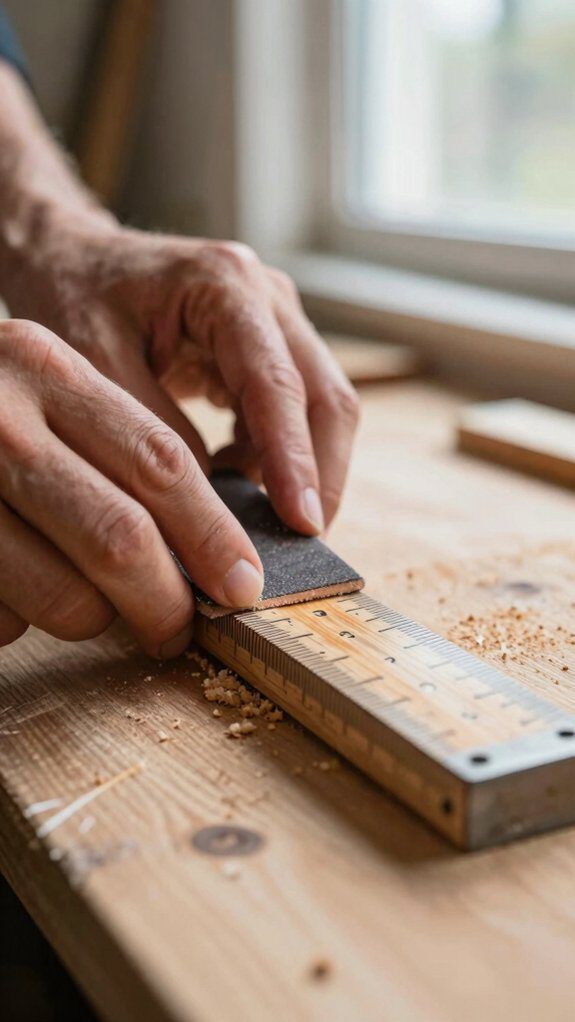
Now that your yardstick pieces are glued together, you’ll want to focus on smoothing those edges and corners—they’re the parts that’ll really catch hands and eyes when someone uses your tray.
I recommend grabbing a fine-grit sanding sponge (120–220 grit works great) and working along the grain with light, even strokes to keep from accidentally buffing away any of those printed numbers or paint.
For those tricky tight corners and inside edges, wrap your sandpaper around a small block or toothpick to stay in control and apply even pressure throughout.
Focus on edges and corners
Smoothing out those rough edges and corners is where your tray really starts to shine—literally! I recommend tackling this pivotal stage with intention:
- Edge restoration requires using medium-grit sandpaper or a sanding sponge to remove splinters and glue squeeze-out systematically around all sides.
- Corner reinforcement happens when you fold sandpaper into narrow strips, carefully working tight spaces without over-rounding delicate edges.
- Final polishing involves switching to 220-grit sandpaper for feathering sharp spots before finishing.
Sand with the grain, rotating your tray constantly for even results. Wipe away dust with a tack cloth, inspect thoroughly under good light, and re-sand any problem areas before applying your chosen finish.
Step 5: Attach Handles
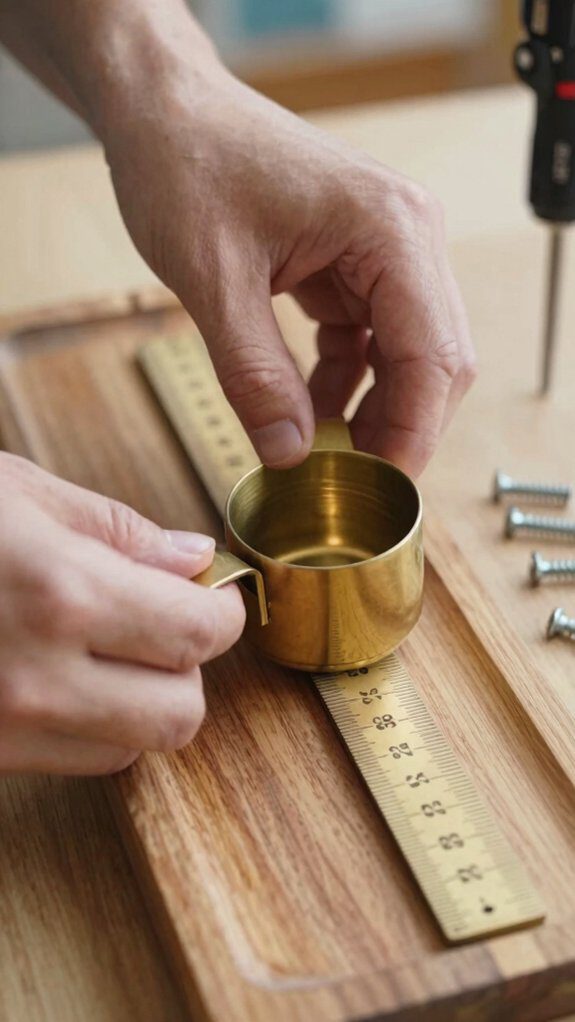
Now that your tray surface is silky smooth, it’s time to add handles that’ll make carrying your creation both practical and stylish.
I’d recommend starting by finding the center of each short end of the tray base and marking it carefully—this is your anchor point for perfectly balanced handles.
From there, you’ll want to position your chosen handles (whether they’re cut-outs, purchased pulls, or something you’ve repurposed) about 3–4 inches from the top edge, which keeps them comfortable to grip without looking cramped.
Center placement guide
To get your handles sitting perfectly centered and balanced, you’ll want to start by finding the exact midpoint of your tray’s short sides. Divide your tray’s width by two—so a 12″ wide tray gets marked at 6″.
Here’s how I make sure perfect center correspondence and handle symmetry:
- Transfer centerline marks to both sides using a ruler
- Position each handle’s midpoint directly over these marks
- Place handles 1″ to 1½” down from the top edge
This setup guarantees comfortable hand clearance while keeping everything balanced. Before securing anything permanently, I always double-check measurements across the entire tray width to confirm even spacing on both sides.
Step 6: Seal and Finish
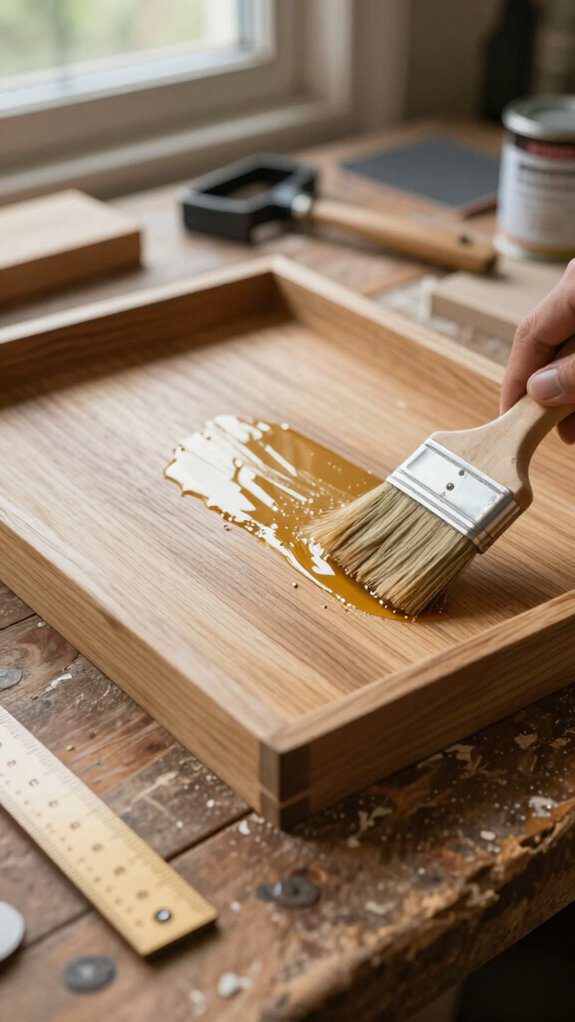
Now comes the fun part—deciding how you want your tray to look! You’ve got options: a dark furniture wax gives your yardstick a rich, classic appearance that shows off the numbers beautifully, while a clear wax or stain lets you customize the color to match your home’s style.
I’ll walk you through both approaches so you can pick the finish that speaks to you.
Clear coat or stain option
Once you’ve sanded your yardstick tray smooth, it’s time to protect all that hard work with a sealer—and you’ve got some great options depending on the look you’re going for.
- Water-based polyurethane offers quick drying (30–60 minutes between coats) with low odor, perfect for busy crafters.
- Oil-based polyurethane or tung oil creates that gorgeous matte finish with authentic charm, though it needs 8–24 hours drying time.
- Gel stain technique deepens wood tones while preserving your printed markings beautifully.
Always test your chosen sealer first on scrap wood.
Apply thin, even layers with foam brushes, sanding lightly between coats with 220-grit for that smooth, professional result you’ll love showing off.
Optional Design Variations
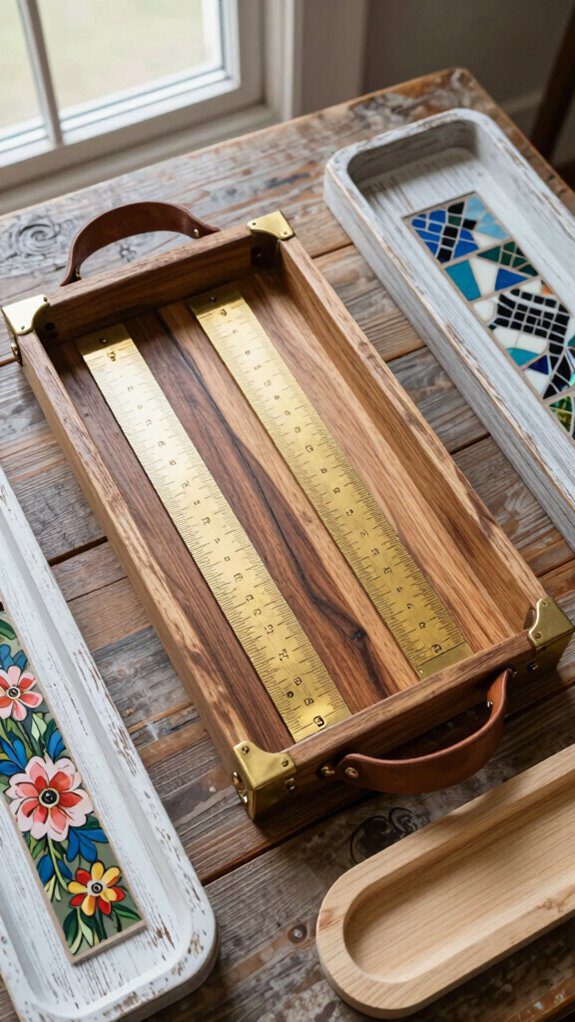
Now that your tray’s sealed and protected, you can really have fun with the design—and I’ve got some gorgeous options that’ll make your creation truly unique.
You can paint a contrasting border around the edges, try a distressed farmhouse finish that shows off those vintage numbers underneath, or even pour an epoxy resin layer on top for a sleek, modern look that catches the light beautifully.
Each style totally transforms how your tray looks and feels, so pick the one that matches your home’s vibe best.
Painted border
When you’re ready to add personality to your yardstick tray, painting the border opens up some really fun possibilities—and I’m excited to walk you through them. Try these approaches:
- Color layering with chalk paint creates stunning contrast—paint your tray center one shade, then the yardstick edges another complementary color for visual depth.
- Brush techniques like dry-brushing darker wax along edges highlight details beautifully, making numerals pop while preserving their character.
- Spray finishes with oil-rubbed bronze or metallic paints give polished, professional results with minimal effort.
Seal everything with polyurethane afterward for lasting protection against spills and daily wear.
Distressed farmhouse look
If you’re drawn to that cozy, lived-in aesthetic that makes a space feel like home, I’ve got something special for you.
Start by lightly sanding with fine-grit sandpaper to dull the finish, then apply a watered-down brown stain, wiping most away so markings peek through.
Next, sand corners more aggressively to mimic natural wear—this chipped paint effect looks authentically vintage.
Rub dark furniture wax into crevices for depth, then buff lightly.
Finally, seal everything with matte polyurethane.
Add antique hardware like brass handles, and you’ve created a tray that whispers stories of simpler times, perfect for displaying treasures or serving treats.
Epoxy resin finish
Take your yardstick tray to the next level with a crystal-clear epoxy resin topcoat that transforms it into a protective, glass-like masterpiece. I love how this finish seals everything beautifully while creating that stunning glossy shine.
Here’s what you’ll do:
- Mix resin and hardener per manufacturer instructions, stirring slowly for 3–5 minutes
- Pour thin flood coats (1/8″–1/4″) on a perfectly level surface, using a heat gun to eliminate bubbles
- Cure for 24–72 hours, then sand lightly and polish for gloss maintenance
Always prioritize resin safety with gloves, eye protection, and ventilation. Your tray’s now restaurant-ready!
Tips for a Sturdy and Long-Lasting Tray
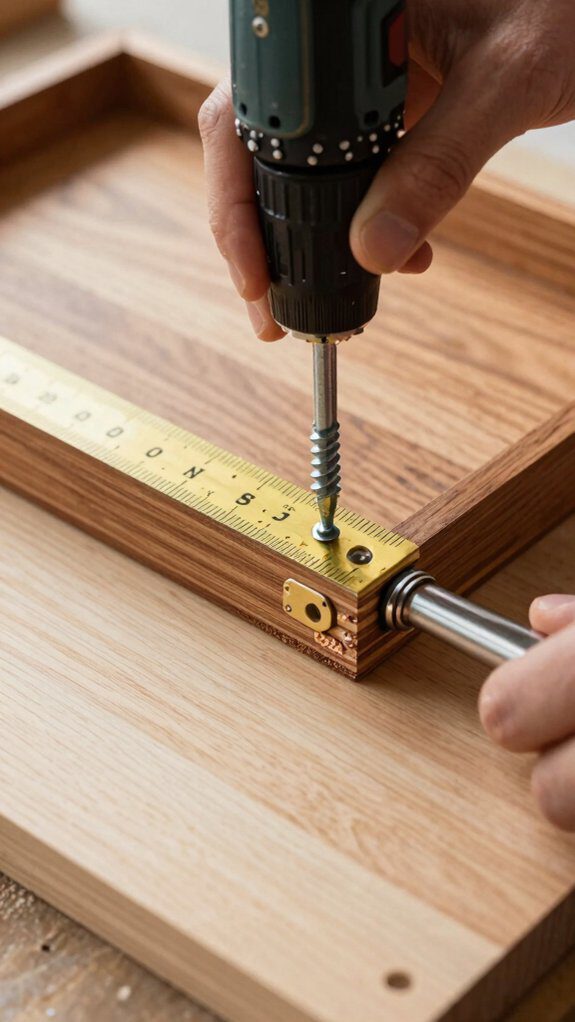
Because a serving tray gets handled, loaded with dishes, and exposed to spills and moisture, you’ll want to build it with durability in mind from the very start.
I reinforce my tray with three cross-supports glued underneath, spaced evenly to prevent warping.
For weatherproofing techniques, I apply two polyurethane coats or furniture wax on all surfaces—top and bottom.
Before assembly, I sand mating surfaces with 120–150 grit sandpaper and seal seams with glue to block moisture.
For load testing methods, I clamp everything overnight for maximum strength.
If carrying heavy items, I back thin edges with 1/8″ plywood backing for extra reinforcement that truly lasts.
Common Mistakes to Avoid
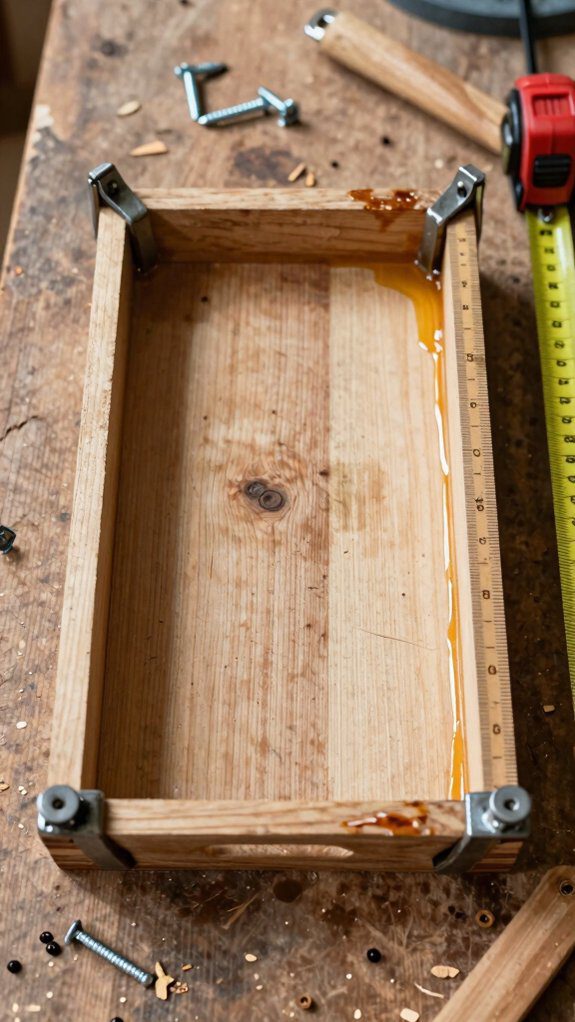
Even with the best intentions, a few missteps during construction can turn your beautiful yardstick tray into something that looks wonky or falls apart.
I’ve learned that avoiding common mistakes makes all the difference:
- Measurement precision – Mismatched yardstick pieces create visible gaps; measure twice and cut with a miter box for perfect positioning
- Adhesive strength – Hot glue alone fails on thin wood; combine wood glue with hot glue, then clamp overnight for durability and serving safety
- Finishing touches – Skipping sanding or polyurethane leaves rough surfaces that absorb spills, compromising tray maintenance and that polished look you’re after
These details matter because they determine whether your tray becomes a cherished kitchen staple or disappoints quickly.